 On Wednesday, May 27th, I will be kick starting The Orson Welles Centennial Celebration, at Huntington’s Cinema Arts Centre. I will introduce Citizen Kane that evening at 7PM. The Lady From Shanghai, on June 18th, Magician: The Astonishing Life And Work of Orson Welles, on June 25th, and Othello, on June 30th; Film Noir Historian Foster Hirsch will introduce Touch of Evil, on June 15th, and Royal Brown will introduce The Trial, on July 8th.
When Newsday commented in the May 24th Sunday edition, that Citizen Kane is considered the greatest film ever made, that may not be a complete exageration. This was Welles’ first film as a director, and he broke all the rules. He redefined what film making was all about,. He also created a storm, since the film was discovered to be loosely inspired by William Randolph Hearst.
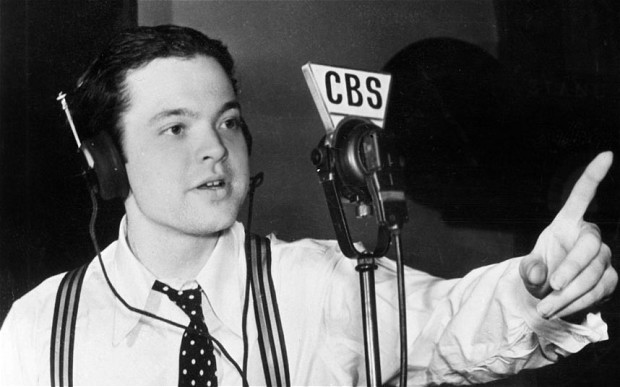
I like to tell a story about Orson Welles, during his years as a radio actor and director. He would do radio, because it made money for his Mercury Theatre. He appeared on all the networks, on all types of radio shows. He was Lamont Cranston, better known as THE SHADOW (“The Shadow knows what evil lurks in the hearts of men…..”). He would appear on Columbia Workshop, The March of Time (a dramatized radio newsreel). Welles could read a script cold. His schedule was so hectic, that he would walk into a studio, be handed a script. Welles would ask, “What am I?”. Oh, a chinese man? And immediately, Welles would speak in that dialect that was required.
These were the days before transcribed programs, so most radio shows were broadcast live. Many programs were 30 minutes, to an hour. Many were 15 minutes. There were times when Welles was finished with one program, and had to get to the next studio anywhere from 15 to 30 minutes to do his next show. How to get through traffic and make good time? It was not always easy to get a cab. Welles found a solution: he made an arrangement with an ambulance service, who would whisk him from one studio,,to another, with sirens blaring. According to Welles, there was no law that stated that you had to be ill to ride in an ambulance.

 Harwood's Hollywood